
Understanding Franchise Territory Rights
Franchising, Franchise Rights, Territory Protection
Franchise Territory Rights, Explained: What “Protected” Actually Means
Many investors see the words “protected territory” in a Franchise Agreement and assume they are buying total exclusivity. In reality, Franchise Rights around territory are far more nuanced—and sometimes far more limited—than buyers expect. Understanding what “protected” really covers (and what it doesn’t) is critical before you commit to a location.
What Territory Protection Really Means in a Franchise Agreement
The first myth to bust: “protected territory” does not have a universal legal definition. It means only what your specific Franchise Agreement says it means. Some brands give strong Territory Protection against any competing units. Others protect you only from additional traditional locations—but still reserve the right to sell online, through supermarkets, kiosks, or non-traditional venues inside your “protected” area.
In many systems, protection is limited to the franchisor not granting another franchise of the same brand within a defined geographic area. That sounds comforting, but it may not stop:
Corporate-owned outlets opening nearby
Online sales delivered into your territory
Sales through third parties (grocery, big-box, delivery-only “ghost” kitchens)
If the agreement is silent or vague, assume the franchisor has kept those rights, not you. Protection is only as strong as the language on the page.
Common Territory Structures: Exclusive, Protected, and Non‑Exclusive
Franchisors typically use one of three basic territory models. The labels can be misleading, so focus on the definitions, not the marketing language.
Exclusive Territories: The strongest form of Franchise Rights. The franchisor agrees not to operate, license, or permit any competing outlets of the same brand in your territory—sometimes including corporate stores and alternative channels. True exclusivity is rarer than buyers think and usually comes with higher fees or performance requirements.
Protected Territories: The most common structure. You are protected from additional franchised locations, but the franchisor often reserves rights for online sales, non-traditional venues, or corporate units. It sounds exclusive, but it is really a limited form of Territory Protection.
Non‑Exclusive Territories: You may receive a suggested area to develop, but the franchisor can place other units nearby or even across the street. This model relies on market demand to support multiple operators and offers the least protection against overlap.
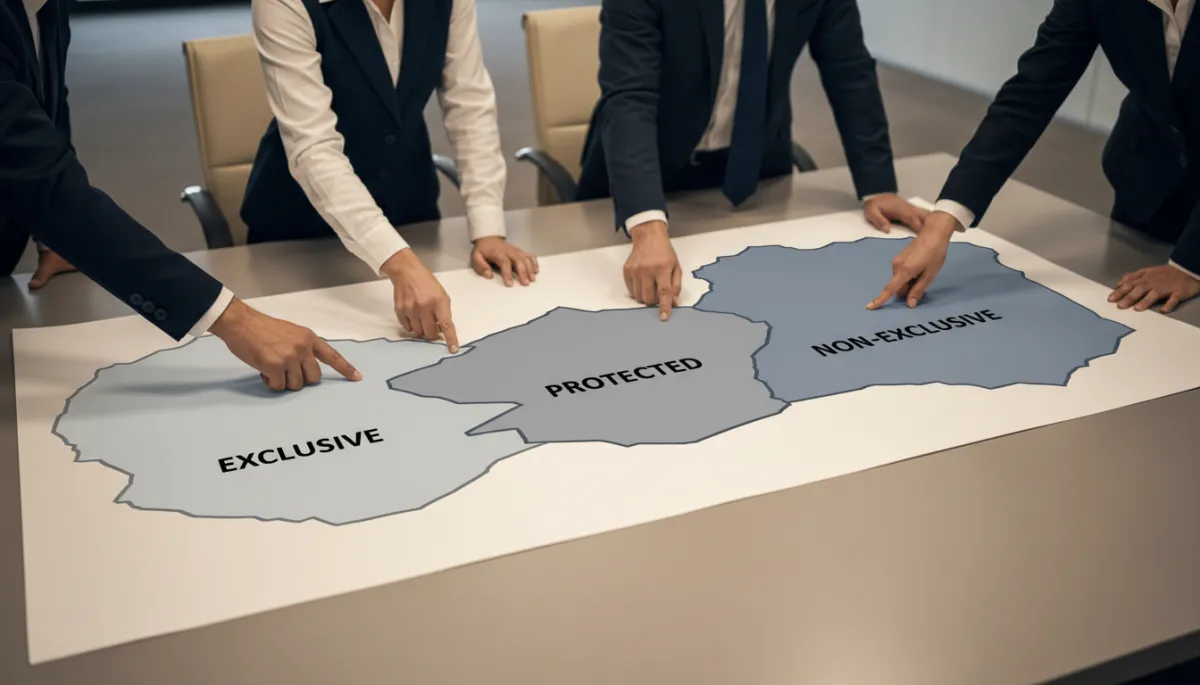
Territory labels matter less than the specific rights and carve-outs in writing.
How Territory Size and Population Are Typically Set
Another common misconception is that bigger is always better. In practice, franchisors design territories based on potential demand, not just square miles. They might define your area by:
A minimum population (for example, 50,000–100,000 residents)
Demographics (household income, age, daytime workers, traffic counts)
Specific boundaries (ZIP codes, counties, drive‑time radiuses)
A compact, densely populated territory can outperform a sprawling suburban one. The key is whether the defined area can realistically support your sales projections and any required multi‑unit development schedule.
What Encroachment and Overlap Look Like in Real Life
Encroachment happens when another unit’s presence or marketing significantly cuts into your customer base. It may not violate the Franchise Agreement, but it can erode your economics. Common scenarios include:
A new location just outside your boundary attracting many of “your” customers
Delivery‑only kitchens or online orders being fulfilled from outside your territory into your area
National promotions that drive traffic to nearby units instead of yours
The agreement may limit your remedies to mediation or internal dispute processes, and some contracts explicitly waive encroachment claims. If you assume you can “fight it later,” you may be disappointed.
Before You Sign: Get Territory Terms Professionally Reviewed
Territory language is one of the most economically important—and most misunderstood—sections of any Franchise Agreement. Do not rely on verbal assurances or sales brochures about Exclusive Territories or “strong Territory Protection.” Only the signed contract controls your Franchise Rights.
Before you commit to a location, sit down with an experienced franchise consultant or franchise attorney and review every clause related to territory, alternative channels, online sales, and encroachment. Ask them to translate the legal language into plain‑English scenarios: where can other units open, how can the brand sell in your area, and what happens if overlap hurts your sales.
The smartest investors are not the ones who assume they are fully protected—they are the ones who know exactly how they are protected, where the gaps are, and whether the opportunity still makes sense. Review your territory terms carefully with a franchise consultant before signing anything, so you understand precisely what you are buying—and what you are not.

