
Recession-Resistant Franchises: Invest Wisely
Franchise Investment, Economic Resilience
Recession-Resistant Franchises: Where Capital Hides When the Cycle Turns
Volatility is back, but the franchise market isn’t blinking. In 2026, U.S. franchising is still projected to add roughly 12,500 units and more than $14 billion in output, even as investors brace for slower GDP growth and tighter credit, according to the International Franchise Association. For high-capital investors, the question isn’t whether to pursue Franchise Investment—it’s which sectors consistently deliver Economic Resilience when consumer confidence cracks.
Essential Services: Demand That Doesn’t Take a Day Off
When households cut back, they don’t stop fixing cars, cleaning spaces, or seeing a doctor. That’s why essential services—from auto repair to cleaning and basic healthcare—consistently rank among the most recession-resilient franchise categories. Historical downturns show auto repair and maintenance volumes rise as consumers hold onto older vehicles rather than buy new ones, while residential and commercial cleaning stay sticky as hygiene and safety remain non-negotiable. Recent franchise outlooks project commercial and residential services output growth of around 3.2% in 2026, outpacing broader franchise averages and underscoring their role as a core Economic Resilience play.
Quotable line: “In a downturn, essential-service franchises don’t chase demand—it comes to them on schedule.”
Budget-Friendly Food & Healthcare: Trading Down, Not Tuning Out
Food and healthcare are the twin pillars of defensive Franchise Investment. Quick-service and budget-friendly food concepts historically hold up when wallets tighten, as consumers trade down from premium dining to value-driven options, not out of the category altogether. Franchise Direct and Entrepreneur both highlight fast food and quick-service restaurants as “recession-proof” segments thanks to consistent, high-frequency demand and strong delivery and drive-thru infrastructure.
On the healthcare side, aging demographics and elevated health awareness are powerful tailwinds. Senior care, physical therapy, and health-and-wellness franchises are projected to grow faster than the overall franchise economy through 2026, supported by non-discretionary spend and recurring-revenue models. In other words, people may postpone vacations—but not prescriptions, rehab, or elder care.
Quotable stat: “Even in choppy markets, food and healthcare franchises sit on top of a demand curve that barely dips.”
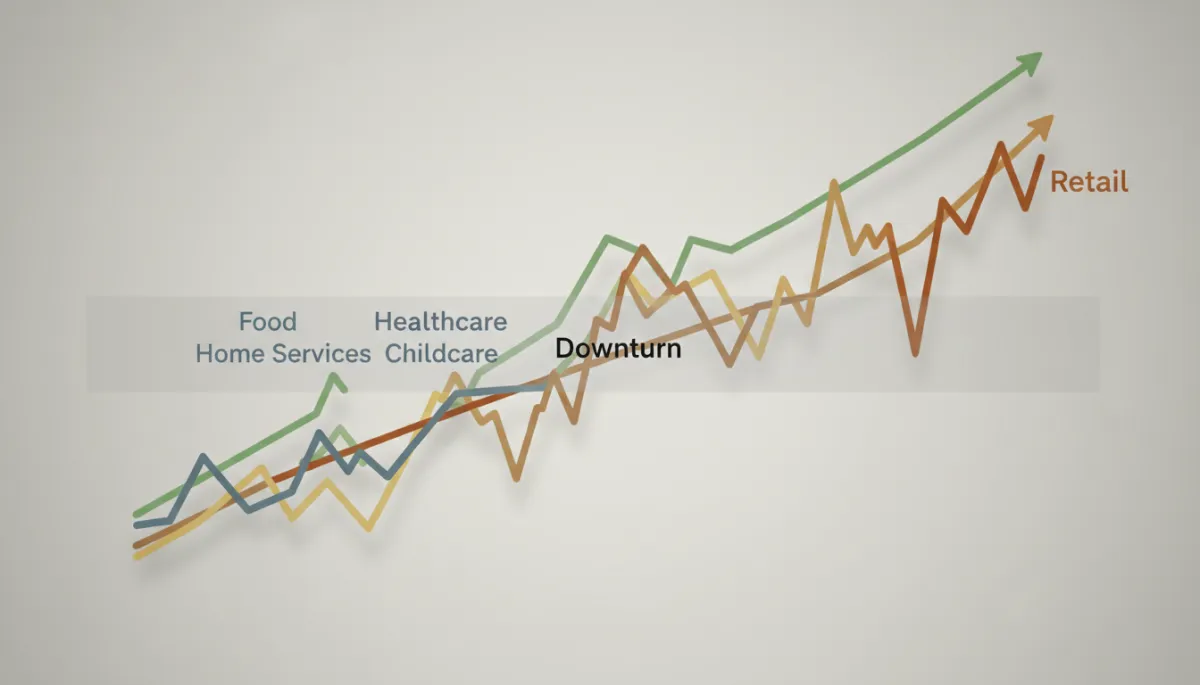
Essential, value, and care-based franchises historically show the flattest revenue curves in recessions.
Home Maintenance & Childcare: Stability Where Families Live and Work
Home maintenance is another quiet winner in every slowdown. When housing markets cool, homeowners shift from renovating and moving to repairing and preserving. That dynamic is fueling above-average growth in home and commercial services franchises—again, roughly 3.2% projected output growth in 2026—with models spanning HVAC, plumbing, restoration, and handyman services. These brands benefit from urgent, needs-based purchases and insurance-backed work, giving investors more predictable cash flow even when consumer sentiment softens.
Childcare and education services are equally compelling. Dual-income households don’t disappear in a downturn, and working parents still need reliable childcare and learning support. Child services and education franchises are projected to post similar ~3.2% output growth, driven by after-school programs, tutoring, and early childhood centers—especially in fast-growing Sun Belt and Midwestern markets. For investors, that means recurring revenue, long-term customer relationships, and a sector where demand is tied more to labor-force participation than to stock-market swings.
Quotable line: “As long as parents work and houses age, childcare and home-service franchises stay booked.”
The Bottom Line for High-Capital Investors
The 2026 franchise landscape is clear: essential services, budget-friendly food, healthcare, home maintenance, and childcare are where Economic Resilience is being priced in. While the broader franchise sector grows a steady 1–2% across key metrics, these categories are quietly outperforming, backed by non-discretionary demand and repeat-use behavior. For investors deploying serious capital, concentrating on these recession-resistant verticals—ideally with tech-enabled, multi-unit potential—isn’t a defensive move. It’s a disciplined strategy to stay on offense when the cycle turns.

