
Universal High Income Sounds Bold. It Also Misses the Harder Question.
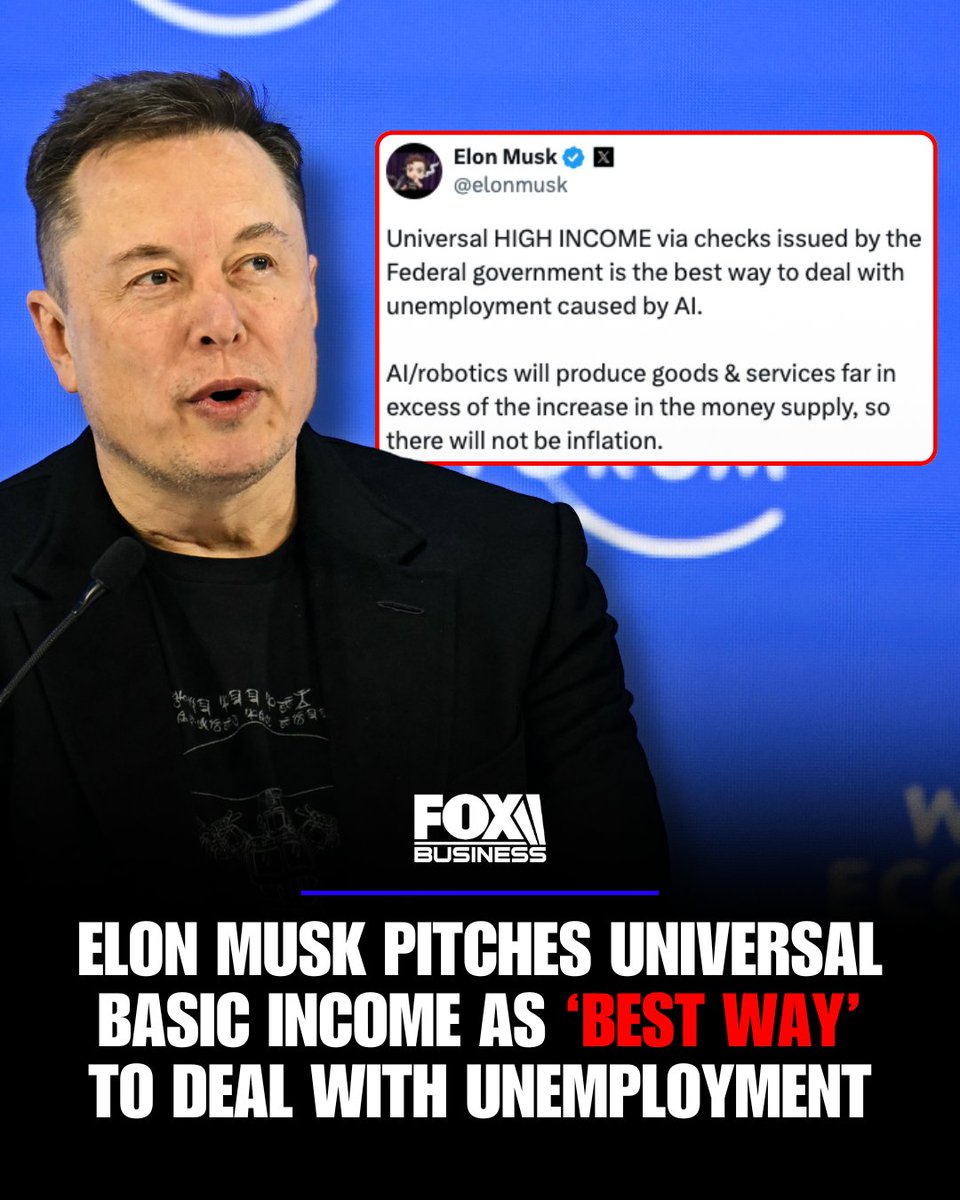
Elon Musk’s latest idea is classic Musk: provocative, simple on the surface, and large enough to dominate the conversation. In response to concerns about AI-driven unemployment, he argued that “universal high income” funded through federal checks is the best answer. His reasoning is that AI and robotics will produce so much abundance that inflation will not follow. Economists quoted in the same Fox Business report were unconvinced, warning that the arithmetic is shaky and that governments cannot spend their way around structural disruption forever.
That debate is worth having.
But it is not the most important one.
The more serious question is not whether governments can mail people checks after AI reshapes the labor market. It is whether leaders, businesses, and workers are preparing for a world in which the value of human labor may change faster than our institutions can absorb.
That is the real story.
We like to talk about artificial intelligence as an efficiency tool because efficiency is comfortable. It fits into existing language. It sounds manageable. It suggests a familiar corporate playbook: automate routine work, cut costs, increase output, improve margins.
That is the easy version of the future.
The harder version is this: AI may not just improve work. It may reorder it.
And when that happens, the conversation changes. It is no longer about productivity software. It is about bargaining power, income security, ownership, and control.
That is why Musk’s comment matters, even if his solution is wrong.
It forces a question most leaders still prefer to postpone: what happens when large numbers of people discover that the market no longer values their labor the way it once did?
For years, the default assumption has been that technology destroys some jobs, creates others, and, over time, the economy adjusts. In the long run, that has often been true. But “in the long run” is not a strategy. It is a slogan people use when they do not yet have an answer for the short and medium term.
And that gap matters.
Because disruption does not arrive as an abstract trendline. It arrives in households, payrolls, business models, and career paths. It arrives in the form of slower hiring, compressed wages, reduced leverage, and fewer clear ladders upward. By the time a shift becomes visible in national statistics, it has already become personal for millions of people.
That is where so much of the AI discussion still feels naïve.
Too many people are speaking as if the only question is whether the technology will be powerful.
That is already clear.
The better question is who will own the systems, who will capture the upside, and what happens to everyone else.
This is where the “universal high income” idea starts to feel less like a solution and more like an admission. If the answer to AI disruption is eventually some form of public distribution, then what we are really acknowledging is that the private economy may not distribute the gains on its own. That is not a technology story. It is a market structure story.
And market structure is where leadership matters.
Because long before governments design new entitlement systems, businesses will have to make decisions. Investors will have to make decisions. Workers will have to make decisions. Families will have to make decisions.
They will all be asking versions of the same question:
How exposed am I to a world that rewards ownership more than labor?
That question is uncomfortable because it cuts through the optimism and goes straight to incentives. AI does not just create tools. It concentrates leverage. The people who control the models, the infrastructure, the customer relationships, the distribution, and the capital stack are positioned to benefit disproportionately. Everyone else is left negotiating with a market that may need less from them than it once did.
That does not mean catastrophe is inevitable. It does mean passivity is dangerous.
The mistake would be to wait for a policy answer before taking a strategic one.
For companies, that means thinking beyond cost savings and asking where AI changes the economics of the industry itself. Which parts of the value chain become commoditized? Which capabilities become more valuable, not less? Where does human judgment still command a premium? Where does trust still matter? Where does speed become decisive? Which roles can be redesigned, and which ones are simply vulnerable?
For individuals, the lesson is even more direct. Depending entirely on earned income in a period of technological transition is a fragile position. The old definition of security—good job, steady paycheck, predictable path—already looked weaker before this wave of AI. It does not look stronger now. Gene’s own public writing repeatedly returns to this same theme: what feels safe can prove fragile, and control over assets, direction, and optionality matters more than the illusion of stability.
That is why the real response to AI disruption is not panic, and it is not blind faith in government support.
It is preparation.
Build assets.
Develop leverage.
Move closer to ownership.
Strengthen judgment.
Become harder to replace.
Position yourself where technology amplifies your value instead of eroding it.
That is not as politically catchy as “universal high income.” But it is more useful.
Because checks, even if they come someday, will always be downstream of power.
The upstream question is who still has agency when the ground shifts.
And that is the leadership test now in front of all of us.
Not whether we can invent a cleaner slogan for redistribution.
Whether we can build people, businesses, and institutions resilient enough to operate in a world where abundance may increase, but security does not automatically increase with it.
That distinction matters.
A society can become more productive and still feel more precarious.
A business can become more efficient and still become more exposed.
A worker can become more technologically enabled and still lose economic leverage.
That is why this moment demands more than optimism.
It demands clarity.
Musk may be right about one thing: AI is going to force a bigger reset than most people are ready for. But if that is true, then the answer cannot begin and end with federal checks. It has to begin with a more honest conversation about value, incentives, ownership, and adaptation.
That is the harder question.
It is also the only one worth leading with.

